

Casino games differ significantly in their long-term mathematical advantage for the house, known as the house edge. This percentage represents the average portion of each bet the casino expects to retain over a large number of plays.
The RTP (Return to Player) is the corresponding percentage of wagered money that the game is expected to pay back to players over time.
Games with lower house edges generally offer better value, particularly when players apply optimal strategy. The figures below assume perfect play, with skill involved and standard rules or paytables. Actual results in any single session can vary widely due to short-term luck.
House Edge and RTP Comparison
| Game | Best Variant / Bet | RTP (%) | House Edge | Skill Required |
|---|---|---|---|---|
| Video Poker | Full-Pay Deuces Wild (optimal strategy) | 100.76 | -0.76% | Very High |
| Video Poker | Full-Pay 9/6 Jacks or Better | 99.54 | 0.46% | High |
| Blackjack | Liberal rules + basic strategy | 99.4 – 99.7 | 0.3% – 0.6% | Very High |
| Craps | Pass/Don’t Pass + maximum Odds | ~99.4 | ~0.6% blended | Medium |
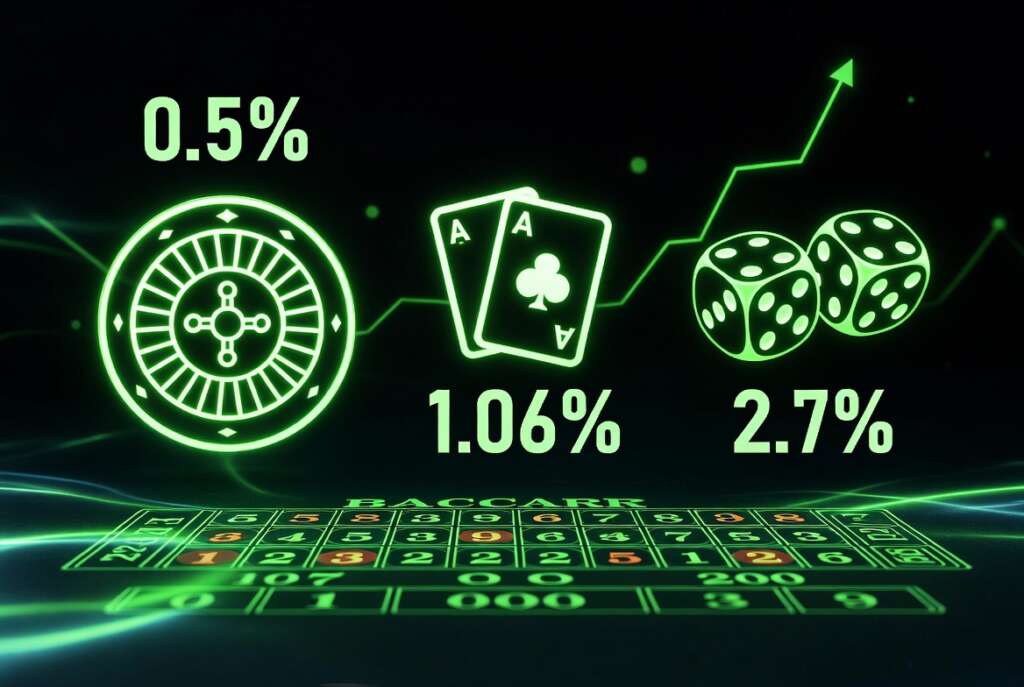
| Baccarat | Banker bet | 98.94 | 1.06% | Low |
| Roulette | European/French with La Partage/En Prison | 98.65 | 1.35% (even bets) | None |
| Roulette | European (single zero) | 97.30 | 2.70% | None |
| Slots | Highest RTP titles | 94 – 99 | 1% – 6%+ | None |
Understanding House Edge and RTP
The house edge is calculated from the game’s rules, probabilities, and payouts. For example, a 1% house edge means that, on average, a player can expect to lose $1 for every $100 wagered over many plays. RTP is simply 100% minus the house edge (expressed as a percentage). These are long-term averages — individual sessions or even thousands of hands can deviate due to variance.
Skill-based games like video poker and blackjack allow players to reduce the edge substantially through correct decisions. Pure chance games like slots or roulette offer no such opportunity.
Video Poker
This is one of the few games where the return can theoretically exceed 100% with certain “full-pay” paytables and flawless strategy. In full-pay Deuces Wild, all 2s act as wild cards, and generous payouts for hands like four deuces or royal flushes create a positive expectation when every hold decision follows the optimal chart. Full-pay 9/6 Jacks or Better (9 for full house, 6 for flush) is the next best common variant.
Always inspect the paytable on screen before playing. Lower payouts on key hands (e.g., 8/5 or 7/5 versions) can drop RTP by 2–3% or more. Strategy charts are widely available online and improve results dramatically compared to intuitive play.
Blackjack
With basic strategy, the house edge drops to very low levels in games offering favourable rules: 3:2 payout on blackjack (instead of 6:5), dealer stands on soft 17, doubling after splits allowed, and surrender options.
Single-deck games can edge out multi-deck versions when rules are equal, but many single-deck tables compensate with weaker payouts that increase the edge. Free basic blackjack strategy charts or apps make optimal play straightforward without needing to memorize every scenario.
Craps
The Pass Line or Don’t Pass bets start with a modest house edge, but the real advantage comes from Odds bets, which pay true mathematical odds and carry zero house edge.
You can place these behind your initial bet once a point is established. The more Odds allowed (e.g., 5x, 10x, or higher), the lower the overall blended house edge becomes for the combined wager. This makes craps one of the better options for players who enjoy table action and can manage the game’s pace.
Baccarat
Extremely straightforward — players choose Banker, Player, or Tie. The Banker bet has the lowest edge (a 5% commission usually applies to wins). The Tie bet carries a much higher edge (around 14%) and is best avoided. Baccarat has low variance on the main bets, making it suitable for longer sessions with smaller swings.
Roulette
European and French wheels (single zero) are far preferable to American wheels (double zero, 5.26% edge). The La Partage or En Prison rules, common on French tables, apply to even-money bets (red/black, odd/even, high/low).
If the ball lands on zero, the player either loses only half the bet (La Partage) or has the bet “imprisoned” for one more spin (En Prison). Either rule effectively halves the house edge on those bets to 1.35%.
Slots
RTP ranges widely depending on the specific title and casino. Even the best slots (some reaching 96–99%) still carry a higher long-term house edge than the skill-based games above.
They provide high variance, occasional large wins are possible, but the math favors the house over extended play. Checking published RTP percentages helps identify stronger options.
High RTP Slots Worth Knowing
Some slots offer much higher RTPs than the usual 94% to 96% range, but you still need to check the game info screen before playing. Casinos can offer different RTP versions of the same slot.
| Slot | Listed RTP | Volatility | What to Note |
|---|---|---|---|
| Book of 99 | 99.00% | High | One of the best-known high RTP slots, but it can still produce sharp swings. |
| Mega Joker | 99.00% | High | The top RTP usually depends on using the Supermeter feature correctly. |
| Ugga Bugga | 98.74% | Low/Medium | Older Playtech slot with frequent smaller wins rather than jackpot-style payouts. |
| 1429 Uncharted Seas | 98.50% | Medium | High RTP for a video slot, with expanding wilds and free spins. |
| Blood Suckers | 98.00% | Low | Lower volatility than most slots, so sessions can feel steadier. |
| Marching Legions | 98.12% | High | Bonus-heavy slot, so the high RTP can still come with long dry spells. |
| The Catfather | 98.10% | Medium | Above-average RTP, but still check which version your casino offers. |
The catch is simple: RTP is theoretical. A 99% RTP slot can still lose money fast if the volatility is high or if you’re playing a lower-return version of the game.
Additional Factors That Affect Value
- Rule and Paytable Variations: Small differences (e.g., number of decks in blackjack, specific payouts in video poker, or maximum Odds in craps) can shift the edge noticeably.
- Online vs Land-Based: Online versions often publish exact RTPs and may offer more liberal rules or full-pay video poker machines that are rarer in physical casinos.
- Variance: Low house edge games can still produce long losing streaks. Higher-variance games like slots may deliver bigger short-term wins but deplete bankrolls faster on average.
- Commissions and Side Bets: Avoid side bets in most games, as they usually carry much higher edges.
Practical Tips for Players
- Check rules or paytables before committing money — even identical-looking games can differ between casinos or platforms.
- Use freely available strategy resources for blackjack and video poker to minimize the house advantage.
- Set a clear session budget and time limit in advance.
- Remember that no strategy eliminates the house edge entirely in most games; these figures represent expectations over very large volumes of play.
Conclusion
All casino games are designed with a built-in advantage for the operator. The information here is intended to help you understand the mathematics behind common options and make more informed choices. Results are never guaranteed, and every session should be viewed as entertainment with an expected cost.
FAQs
Full-pay video poker can have the lowest house edge, but only if you find the right paytable and play perfect strategy. Full-pay Deuces Wild can even return above 100% in theory, while 9/6 Jacks or Better sits around 99.54% RTP. Blackjack, craps with odds, baccarat Banker, and French roulette are also among the strongest options.
Blackjack is only low edge when the rules are fair and you use basic strategy. Look for 3:2 blackjack payouts, dealer stands on soft 17, double after split, and surrender where available. A 6:5 blackjack table can wipe out much of the value, even if the game looks similar at first glance.
Some slots list RTPs of 96% to 99%, but they still behave differently from table games. Slots usually have higher variance, so your bankroll can swing harder even when the RTP looks strong. Published RTP helps you avoid weak titles, but it doesn’t give you control over the result.
The Banker bet has the lowest house edge in baccarat because it wins slightly more often than the Player bet. Most casinos take a 5% commission on Banker wins, but it still usually works out as the best main bet. The Tie bet is the one to avoid because its house edge is much higher.
No. A low house edge only means the game is mathematically cheaper over a very large number of bets. You can still lose quickly in a short session, especially in higher-variance games. The edge tells you the expected cost of playing, not what will happen today.