
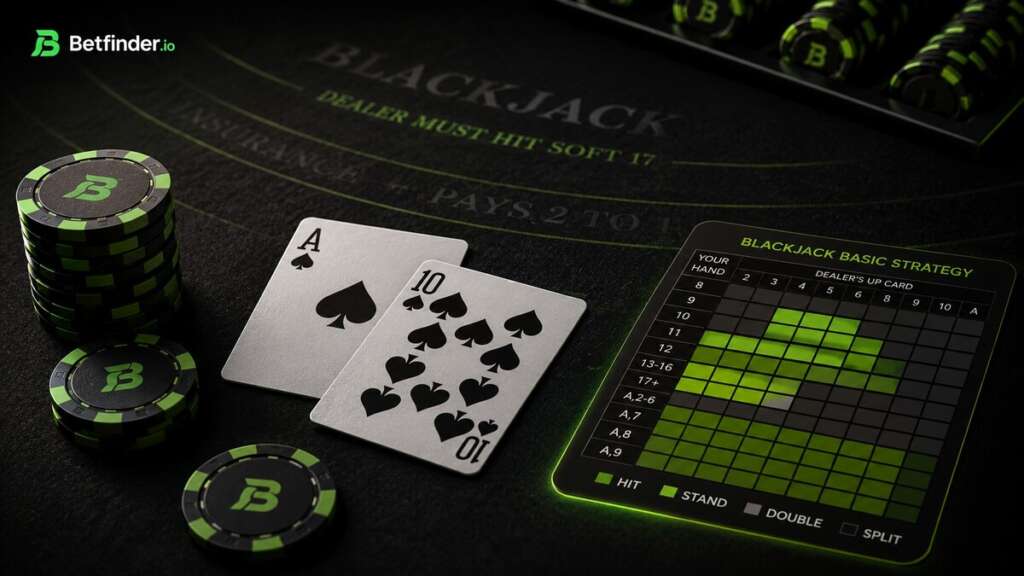
Blackjack is one of the few casino games where your decisions change the house edge.
That doesn’t mean you can beat the game just by following a chart. It means you can stop giving away extra value on hands where the correct move is already known.
Basic strategy is “the book.” It tells you whether to hit, stand, double, split, or surrender based on your hand and the dealer’s upcard.
The charts below are based on a common online and casino rule set:
- Multi-deck blackjack
- Dealer stands on soft 17
- Double after split allowed
- No surrender
Different rules can change a few decisions, especially soft 17, surrender, and doubling rules. The useful bit: the main patterns stay the same.
Want to test your decisions? Try our blackjack strategy trainer and get instant feedback on when to hit, stand, double, or split.
What Blackjack Basic Strategy Actually Means
Blackjack basic strategy is the mathematically best play for each starting hand against each dealer upcard.
It does not predict the next card. It does not guarantee a winning session. It simply gives you the lowest-cost decision over the long run.
That matters because blackjack is not like roulette or slots, where your choices rarely affect the house edge. In blackjack, bad decisions cost real money.
Standing on 16 against a dealer 10 feels safer, but basic strategy says to hit in most games. Splitting 10s looks tempting, but basic strategy says to stand. Taking insurance feels protective, but it’s usually one of the worst bets on the table.
The book is boring. That’s why it works.
Blackjack Basic Strategy Chart: Hard Hands
A hard hand has no ace counted as 11. For example, 10-6 is hard 16. So is 9-7.
Use this chart when your hand is a hard total.
| Your Hand | 2 | 3 | 4 | 5 | 6 | 7 | 8 | 9 | 10 | A |
|---|---|---|---|---|---|---|---|---|---|---|
| 5-8 | H | H | H | H | H | H | H | H | H | H |
| 9 | H | D | D | D | D | H | H | H | H | H |
| 10 | D | D | D | D | D | D | D | D | H | H |
| 11 | D | D | D | D | D | D | D | D | D | H |
| 12 | H | H | S | S | S | H | H | H | H | H |
| 13 | S | S | S | S | S | H | H | H | H | H |
| 14 | S | S | S | S | S | H | H | H | H | H |
| 15 | S | S | S | S | S | H | H | H | H | H |
| 16 | S | S | S | S | S | H | H | H | H | H |
| 17+ | S | S | S | S | S | S | S | S | S | S |
Key:
H = Hit
S = Stand
D = Double if allowed, otherwise hit
The main takeaway is simple: dealer 2-6 is the weak zone. You stand more often because the dealer has a higher bust risk.
Dealer 7-A is different. You usually need to improve your hand because the dealer is less likely to bust.
Blackjack Basic Strategy Chart: Soft Hands
A soft hand includes an ace counted as 11. For example, A-6 is soft 17.
Soft hands are where casual blackjack players often lose value. The ace gives you more flexibility, which means doubling can be correct more often than people expect.
| Your Hand | 2 | 3 | 4 | 5 | 6 | 7 | 8 | 9 | 10 | A |
|---|---|---|---|---|---|---|---|---|---|---|
| A-2 | H | H | H | D | D | H | H | H | H | H |
| A-3 | H | H | H | D | D | H | H | H | H | H |
| A-4 | H | H | D | D | D | H | H | H | H | H |
| A-5 | H | H | D | D | D | H | H | H | H | H |
| A-6 | H | D | D | D | D | H | H | H | H | H |
| A-7 | S | D | D | D | D | S | S | H | H | H |
| A-8 | S | S | S | S | S | S | S | S | S | S |
| A-9 | S | S | S | S | S | S | S | S | S | S |
Key:
H = Hit
S = Stand
D = Double if allowed, otherwise hit
Soft 18 is the hand that catches people out. A-7 looks strong, but it’s not always a stand.
Against dealer 3-6, doubling is usually the better play. Against 9, 10, or ace, soft 18 is weaker than it looks, so hitting is the book play.
Blackjack Basic Strategy Chart: Pairs
Pairs create the biggest gap between “what feels right” and what the maths says.
Splitting 8s feels ugly because you’re putting more money into a bad spot. But hard 16 is so poor that splitting usually loses less over time.
Splitting 10s is the opposite. It feels exciting, but you’re breaking up one of the strongest hands in the game.
| Pair | 2 | 3 | 4 | 5 | 6 | 7 | 8 | 9 | 10 | A |
|---|---|---|---|---|---|---|---|---|---|---|
| A-A | P | P | P | P | P | P | P | P | P | P |
| 10-10 | S | S | S | S | S | S | S | S | S | S |
| 9-9 | P | P | P | P | P | S | P | P | S | S |
| 8-8 | P | P | P | P | P | P | P | P | P | P |
| 7-7 | P | P | P | P | P | P | H | H | H | H |
| 6-6 | P | P | P | P | P | H | H | H | H | H |
| 5-5 | D | D | D | D | D | D | D | D | H | H |
| 4-4 | H | H | H | P | P | H | H | H | H | H |
| 3-3 | P | P | P | P | P | P | H | H | H | H |
| 2-2 | P | P | P | P | P | P | H | H | H | H |
Key:
P = Split
H = Hit
S = Stand
D = Double if allowed, otherwise hit
Two rules stand out:
- Always split aces and 8s
- Never split 10s
That’s the short version. The table handles the awkward middle hands.
Rules That Change the Strategy
Blackjack tables don’t all use the same rules. Small rule changes can move the house edge and change the correct play on some hands.
| Rule | Better or worse for you? | Why it matters |
|---|---|---|
| Blackjack pays 3:2 | Better | This is the normal payout you want |
| Blackjack pays 6:5 | Worse | It cuts the value of natural blackjacks |
| Dealer stands on soft 17 | Better | The dealer stops more often on a vulnerable total |
| Dealer hits soft 17 | Worse | The dealer gets another chance to improve |
| Double after split allowed | Better | Lets you press strong split hands |
| Surrender available | Better | Lets you cut the loss on some poor matchups |
| Fewer decks | Usually better | Single and double-deck games can be stronger if other rules are fair |
| Side bets offered | Usually worse | Most side bets carry a higher house edge than the main game |
The biggest warning sign is 6:5 blackjack.
A £10 blackjack should pay £15 at a 3:2 table. At a 6:5 table, it pays £12. That £3 difference sounds small, but it adds up quickly because blackjacks are one of the best outcomes in the game.
The Biggest Blackjack Mistakes That Cost Value
Most blackjack mistakes come from trying to protect a hand instead of following the maths.
Taking Insurance
Insurance is usually a bad bet unless you’re counting cards and know the deck is rich in 10-value cards.
For most players, it’s an extra side bet with poor value. It feels sensible because the dealer has an ace. That feeling is the trap.
Standing Too Often on 12 to 16
Weak hands feel uncomfortable, so many players stand and hope the dealer busts.
That works against weak dealer cards. It’s usually wrong against 7, 8, 9, 10, or ace.
Hard 16 against a dealer 10 is ugly either way. Basic strategy says hitting loses less over the long run than standing.
Not Doubling Enough
Doubling is where blackjack gives you a real decision edge.
Hands like 10 or 11 against weak dealer cards are strong spots. Soft hands against dealer 4-6 can also be good doubling spots.
If you never double, you leave value on the table.
Splitting Badly
Some splits are automatic. Aces and 8s should be split.
Others are traps. Splitting 10s is the classic one. A total of 20 is already a premium hand, so breaking it into two weaker hands usually makes no sense.
Playing Side Bets
Side bets can be fun, but most are priced worse than the main blackjack game.
Perfect Pairs, 21+3, Lucky Ladies, and similar side bets usually add volatility and house edge. Fine if you want the sweat. Bad if you’re trying to keep the game efficient.
Basic Strategy vs Card Counting
Basic strategy and card counting are not the same thing.
Basic strategy tells you the best play before you know what cards are left in the shoe. It assumes you are not tracking the deck.
Card counting adjusts bets and some plays based on the cards already seen. That is a separate skill, and it’s much harder to use online because many digital blackjack games reshuffle after every hand or use continuous shuffling.
For most players, basic strategy is the practical tool. It won’t turn blackjack into a guaranteed profit game, but it can keep the house edge low when the table rules are fair.
Best Blackjack Rules to Look For
The best blackjack games usually combine fair payouts with flexible player rules.
| Feature | Best option | Avoid |
|---|---|---|
| Blackjack payout | 3:2 | 6:5 |
| Dealer soft 17 rule | Dealer stands | Dealer hits |
| Doubling | Any first two cards | Only 9-11 or 10-11 |
| Double after split | Allowed | Not allowed |
| Surrender | Available | Not available |
| Decks | Fewer decks, if rules are fair | Many decks with poor rules |
| Side bets | Optional and ignored | Heavy side-bet focus |
A 3:2 blackjack table with decent doubling rules is usually a better choice than a flashy 6:5 table with side bets and branding.
The plain table often gives you the better game.
Can Blackjack Basic Strategy Beat the Casino?
Basic strategy lowers the house edge, but it does not remove it.
Under good rules, blackjack can have one of the lowest house edges in the casino. Under bad rules, especially 6:5 payouts, that advantage shrinks quickly.
That’s the real lesson. Basic strategy matters, but table selection matters too.
A good player on a bad table can still be playing a poor game. A basic strategy player on a fair 3:2 table is usually in a much stronger spot than someone guessing their way through a worse rule set.
Betfinder Take
Blackjack basic strategy is not a magic trick. It’s a leak-stopper.
It tells you when to hit uncomfortable totals, when to double instead of playing safe, and when to split hands that look awkward. It also stops you from making expensive “common sense” plays like taking insurance or splitting 10s.
The best version of blackjack is still simple: find 3:2 payouts, avoid bad side bets, use the chart, and don’t confuse short-term results with good decisions.
If you want the lowest-cost way to play casino games, blackjack with proper basic strategy belongs near the top of the list.