
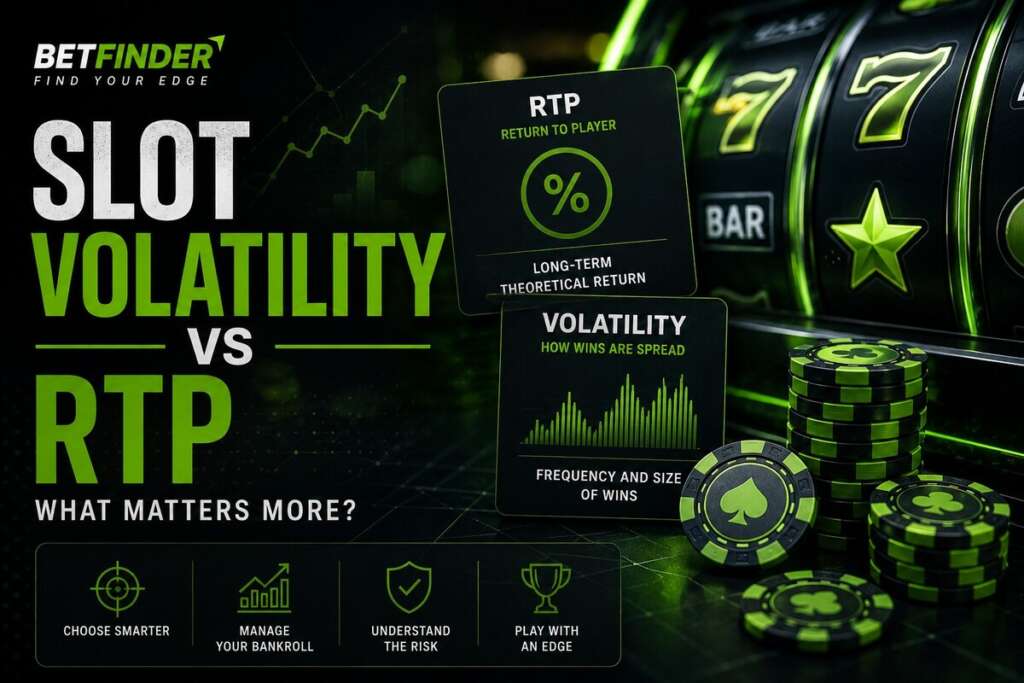
Slot RTP and volatility tell you different things. RTP tells you the game’s long-term return. Volatility tells you how bumpy the ride is likely to feel before that long-term maths has any chance to show up.
That difference matters.
A 96% RTP slot can still burn through a small balance quickly if it’s high volatility. A lower-volatility slot may give you more frequent returns, but the top prizes are usually smaller.
If you only check RTP, you’re missing half the story.
What RTP Tells You
RTP means return to player. It shows the percentage of total stakes a slot is designed to pay back over a large number of spins.
A slot with 96% RTP is designed to return £96 for every £100 staked over the long run. The house edge is the other 4%.
That does not mean you’ll get £96 back from a £100 session. You might cash out ahead. You might lose the lot. RTP only starts to make sense across huge numbers of spins, not one evening on your phone.
That’s the first mistake many people make. They treat RTP like a short-term refund rate. It isn’t.
What Slot Volatility Tells You
Slot volatility, also called variance, tells you how the wins are likely to be spread.
Low-volatility slots usually pay smaller prizes more often. High-volatility slots usually pay less often, but the biggest wins can be much larger.
Medium volatility sits between the two.
Here’s the simple version:
| Volatility type | Win pattern | Typical session feel | Main trade-off |
|---|---|---|---|
| Low volatility | Smaller wins, more often | Balance lasts longer | Lower top-end prize potential |
| Medium volatility | Mixed win sizes | More balanced | Still some dry spells |
| High volatility | Fewer wins, bigger spikes | Bigger swings | Balance can drop fast |
| Very high volatility | Long dry runs, huge upside | Harsh unless bankrolled | Big wins are rare |
Volatility does not tell you whether a slot is “good” or “bad.” It tells you what kind of risk you’re taking.
That’s useful before you choose a game, set a stake, or play through a bonus.
RTP vs Volatility: Quick Comparison
RTP and volatility are often mentioned together, but they answer different questions.
| Factor | RTP | Volatility |
|---|---|---|
| What it measures | Long-term theoretical return | How wins are spread |
| Best used for | Comparing expected cost | Choosing a game style |
| Main risk | Treating it as a session promise | Ignoring bankroll swings |
| Example | 96% RTP | Low, medium, or high variance |
| Affects short sessions? | Not reliably | Yes, much more directly |
| Best question to ask | “What is the long-term cost?” | “Can my balance handle this game?” |
Two slots can both have 96% RTP and feel completely different.
One might return regular small wins and keep you spinning for longer. The other might go quiet for 80 spins, then throw in a 200x bonus. Same RTP. Different ride.
Why High RTP Doesn’t Always Mean Lower Risk
A higher RTP is usually better, but it does not remove volatility.
A 97% RTP high-volatility slot can still be brutal over a short session. The return is tied up in rare features, multipliers, jackpots, or bonus rounds that don’t land often.
That’s why a high RTP slot can still feel worse than a lower RTP slot if your bankroll is too small for the variance.
The useful question is not only “what is the RTP?”
It’s also:
- How often does the game tend to pay?
- Are most prizes small, or is the paytable top-heavy?
- Is the bonus round rare but powerful?
- Does the game have huge multipliers or a progressive jackpot?
- Can your bankroll survive the dry spells?
RTP tells you the game’s built-in cost. Volatility tells you how quickly that cost can show up.
Which Matters More for Bonus Wagering?
Volatility often matters more than RTP when you’re clearing a casino bonus.
A high RTP slot is useful, but only if your balance survives long enough to complete the wagering. High-volatility games can wreck that plan because long dry spells can kill your bonus funds before you get near the rollover target.
Low or medium-volatility slots are usually better for wagering because they return smaller wins more often. That helps keep the balance alive.
Here’s the trade-off:
| Bonus goal | Better fit | Why |
|---|---|---|
| Clear wagering steadily | Low or medium volatility | Fewer dead stretches |
| Chase a big bonus balance | High volatility | More upside, more risk |
| Protect a small bonus | Low volatility | Balance lasts longer |
| Use a large bonus bankroll | Medium or high volatility | More room to absorb swings |
| Avoid fast bust-outs | Low volatility | Smaller swings |
A high-volatility slot can still clear a bonus if it hits early. The problem is the path. You may never get enough returns to complete the wagering.
For bonus play, survival matters.
Which Matters More for Jackpot Slots?
Volatility matters a lot on jackpot slots.
Progressive jackpots and huge max-win slots are usually high volatility because more of the return is tied to rare outcomes. That’s the whole point. You’re giving up regular returns for a shot at something bigger.
That can be fine if you know what you’re playing.
It’s a poor fit if you’re expecting steady returns from a small deposit.
| Slot type | Likely volatility | Better suited to |
|---|---|---|
| Classic fruit-style slots | Low to medium | Longer sessions, smaller stakes |
| Bonus-heavy video slots | Medium to high | Feature hunting |
| Megaways-style slots | Often high | Bigger swings |
| Progressive jackpots | High or very high | Jackpot chasing |
| Cluster pays with multipliers | Medium to high | Bonus-round upside |
The headline prize is only one part of the game. The harder question is how much return is locked behind rare features.
How to Match Slot Volatility to Your Bankroll
Your bankroll should decide how much volatility you can handle.
A £20 balance on a £1 spin gives you 20 spins. That’s thin, especially on a high-volatility slot. A dry run can end the session before the game has a chance to show its stronger features.
A £20 balance on 20p spins gives you 100 spins. That doesn’t guarantee anything, but it gives you more room.
| Your aim | Better fit | Why |
|---|---|---|
| Longer session | Low volatility | More frequent returns |
| Small bankroll | Low volatility or lower stakes | Less chance of a quick bust |
| Bonus wagering | Low or medium volatility | Balance survives longer |
| Big win hunting | High volatility | More top-heavy upside |
| Short entertainment session | Medium volatility | Mix of activity and upside |
| Jackpot chasing | High or very high volatility | Built around rare large wins |
The stake matters as much as the slot.
A high-volatility game at 20p can be more manageable than a low-volatility game at £2 if your balance is small.
Signs a Slot May Be High Volatility
Not every slot clearly labels volatility. Some do. Some don’t.
You can often spot high-volatility signs in the game rules and paytable:
- Large max win, such as 5,000x, 10,000x, or more
- Bonus buy feature
- Rare free spins trigger
- Huge multipliers
- Progressive jackpot
- Very top-heavy paytable
- Long gaps between meaningful wins
None of these proves the exact volatility level on its own. But they’re strong clues.
A slot with a massive max win usually has to pay for that upside somewhere. The cost is often fewer strong hits in regular play.
Common RTP and Volatility Mistakes
The biggest mistake is treating RTP like a short-session forecast.
A 96% RTP game can still take your full balance in minutes. A 94% RTP game can still pay well in one session. RTP is not a prediction for your next 50 spins.
Other common mistakes include:
- Picking the highest RTP game without checking volatility
- Playing jackpot slots with a tiny bankroll
- Using high-volatility slots for strict bonus wagering
- Assuming a cold slot is “due”
- Raising stakes after a dry run
- Ignoring the paytable and max win
- Playing side features without checking how they affect total stake
The “due a win” mistake is the costly one. Slots use random outcomes. A losing run does not make the next spin stronger.
RTP vs Volatility: Which One Matters More?
RTP matters more for long-term expected cost. Volatility matters more for how your balance behaves in a real session.
For most players, the smart answer is to use both.
Start with RTP to avoid poor-value games. Then use volatility to choose a slot that suits your bankroll and goal.
| If you care about… | Look at… |
|---|---|
| Long-term expected return | RTP |
| Session length | Volatility |
| Bonus wagering | Volatility first, then RTP |
| Jackpot chasing | Volatility and max win |
| Lower-risk play | Low volatility and sensible stakes |
| Big upside | High volatility and enough bankroll |
RTP is the maths. Volatility is the experience.
You need both to make a sensible choice.
Betfinder Take
High RTP is useful, but it doesn’t make a slot low-risk.
A 96% RTP high-volatility slot can still be rough on a small balance. A medium-volatility slot with slightly lower RTP may give you a steadier session, especially when bonus wagering is involved.
Use RTP to avoid expensive games. Use volatility to avoid picking a game that doesn’t fit your bankroll.
That’s the real difference.
RTP tells you what the game is designed to return over time. Volatility tells you whether you’re likely to survive long enough to care.
Sources
- Return to Player: How Much Gaming Machines Payout (gamblingcommission.gov.uk)
- Key Terms Relating to Live Return to Player Performance Monitoring of Games (gamblingcommission.gov.uk)
- How Can Gaming Machines Meet Their %RTP? (gamblingcommission.gov.uk)
- RTP Explained: Understanding Return to Player in iGaming (watechnology.com)
- RTP and Volatility Information (bet365.es)