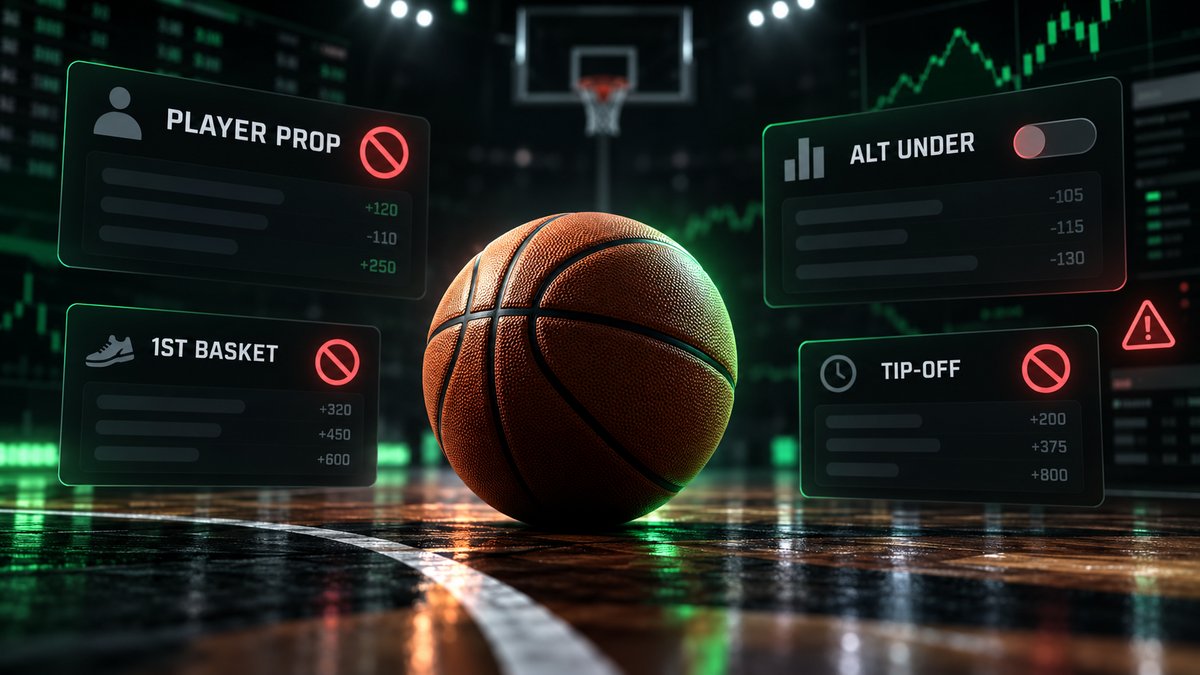
The NBA has introduced new restrictions on player prop bets ahead of the 2026/27 season, targeting wagers considered particularly vulnerable to manipulation.
Announced on October 16, the changes affect same-player under parlays, first-basket markets and several other wagers. Major sportsbooks, including DraftKings and FanDuel, are covered by the restrictions, which follow gambling investigations involving NBA players.
Which NBA Player Prop Bets Are Being Banned?
The NBA is removing selected betting markets where a player’s individual actions or limited playing time could have an outsized influence on the result.
The restrictions include:
- Same-player under parlays: Combining multiple unders on one player’s statistics, such as points, rebounds and assists.
- Low-minute player unders: Under bets involving players averaging or expected to play fewer than 12 minutes per game.
- First-event bets: Markets covering the opening tip, first basket, first three-pointer, first rebound, assist, steal or block.
- Specific missed shots: Wagers on whether a player misses a particular shot attempt.
- Alternative unders: Certain alternate under lines offering unusually large payouts.
The NBA has also maintained previous restrictions involving players on 10-day or two-way contracts, turnovers, fouls and missed free throws.
Importantly, this is not a blanket ban on NBA player props. Standard points, rebounds and assists markets can still be offered, subject to the new conditions.
The same restrictions are scheduled to apply to WNBA games from 2027.
Why Has the NBA Introduced These Betting Restrictions?
The NBA wants to remove wagers that can be manipulated without changing the outcome of a game.
A player leaving the court early might have little influence on the final score. But if someone has backed that player’s points, rebounds and assists to finish below several betting lines, an unexpected early exit could decide every leg of the parlay.
The Jontay Porter gambling scandal exposed that vulnerability.
In April 2024, the NBA banned the former Toronto Raptors player for life after finding that he disclosed confidential health information to a sports bettor, limited his participation in games for betting purposes and placed bets on NBA games.
The NBA revealed that an associate had placed an $80,000 parlay wager, potentially returning $1.1 million, on Porter underperforming in a March 2024 game.
Porter played just three minutes. The suspicious wager was frozen and never paid out.
He later pleaded guilty to conspiracy to commit wire fraud.
Former Miami Heat guard Terry Rozier has also faced federal gambling-related charges concerning allegations of insider information about his playing time. Rozier has pleaded not guilty.
For the NBA, the concern is clear: individual statistical unders can create opportunities for manipulation that ordinary match-winner markets do not.
What Changes for DraftKings, FanDuel and Bettors?
The immediate impact is a smaller selection of specialist player props and same-game parlay combinations.
For example, a parlay combining the same player’s under 15.5 points, under 5.5 rebounds and under 3.5 assists would fall foul of the new restrictions.
Individual statistical unders are not automatically prohibited across the board. What matters is the type of wager, how the selections are combined and whether the player falls within the playing-time restrictions.
First-basket and opening-tip bets are also among the casualties. These markets have long appealed to bettors chasing larger payouts from a single moment of a game.
The changes apply through the NBA’s agreements with its authorized sportsbook partners. Exact market availability may still differ between operators and jurisdictions.
For anyone comparing prices, Betfinder’s Odds Scanner remains a useful tool for spotting out-of-line bookmaker odds in supported markets. It does not currently provide dedicated NBA player prop comparisons.
The Prediction Markets Loophole
The NBA’s restrictions highlight a separate problem: prediction markets do not necessarily operate under the same rules as state-licensed sportsbooks.
Platforms offering sports-related event contracts operate within a different regulatory framework, and the NBA does not have the same commercial control over their markets.
That means a betting product removed by DraftKings or FanDuel might not be subject to an equivalent restriction on a prediction market platform.
It does not guarantee the same wager will be available elsewhere. The bigger issue is that the league cannot apply its sportsbook restrictions uniformly across every platform offering sports-related contracts.
The distinction adds another dimension to the ongoing debate over prediction markets and sports betting regulation.
NBA Expands Betting Monitoring and Player Education
The restrictions form part of a wider integrity and player-protection program.
The NBA is strengthening suspicious betting monitoring and introducing mandatory in-person education for players, coaches and training staff.
Former NFL player and FBI agent Charles Tillman is involved in delivering the training.
The league is also expanding measures against betting-related harassment, including improved reporting channels and support for players facing abuse.
Separately, the NBA and WNBA announced a new responsible gaming campaign on October 13, covering both traditional sports betting and prediction markets.
Betfinder Take: The NBA Is Targeting the Most Vulnerable Markets
The NBA has chosen a targeted approach rather than banning player props entirely.
That seems reasonable. A standard points total is a different proposition from a collection of statistical unders that could all be decided by one player’s early departure.
The unanswered question is whether removing these markets genuinely reduces suspicious betting activity or shifts it towards other products and operators.
Either way, bettors should expect fewer specialist props and same-game parlay options when the NBA season opens on October 20.
The restrictions might frustrate fans of novelty markets, but the Porter case demonstrated why the NBA felt it needed to act.
Sources
- SBC Americas, October 16, 2026 – NBA guidance and sportsbook responses.
- NBA Official Statement, April 17, 2024 – Jontay Porter investigation and lifetime ban.
- Front Office Sports, October 16, 2026 – Market restrictions and prediction market implications.