
No KYC crypto casinos sell speed. Sign up with an email, deposit from a wallet, play within minutes, then withdraw without uploading a passport.
That can happen. The problem is the word “can.”
The no KYC claim usually applies to the start of the journey. The terms often tell a different story at the end, especially when you try to withdraw, win big, use bonuses, trigger wallet checks, or play from a restricted location.
The catch? A casino can feel anonymous right up to the point where your balance matters.
Terms checked: 20 June 2026. We checked the live casino terms, AML policies and withdrawal pages before writing this. The key detail: “no KYC” often means no ID at signup, not no ID in every withdrawal case.
No KYC Often Means No ID at Signup
Most no KYC crypto casinos remove the first layer of friction. You don’t always need to send a passport, proof of address, bank statement, selfie, or source-of-funds documents before you deposit.
That’s the part affiliate lists love to shout about.
For small crypto deposits and routine withdrawals, the setup can work exactly as advertised. You create an account, use BTC, ETH, USDT, LTC, DOGE, or another supported coin, and get paid once the withdrawal passes internal checks and is confirmed on the blockchain.
That’s the good bit.
The weaker bit is the wording buried in AML policies and terms. Many sites reserve the right to request documents later. Not always. Not for everyone. But usually, when the withdrawal is more important than the signup.
The Real Question Is When KYC Starts
A useful no KYC casino review shouldn’t stop at signup. It should answer one question:
What has to happen before the site asks for ID?
That’s where the market gets messy.
Some casinos only ask for documents during fraud reviews. Some ask after large withdrawals. Some ask when cumulative activity crosses a threshold. Some don’t publish a clear threshold at all.
That last one is the problem. If the trigger is hidden, you don’t really know whether you’re using a no KYC casino or just delaying the ID check.
CoinCasino: The Marketing Sounds Cleaner Than the AML Policy
CoinCasino appears on plenty of no-KYC casino lists, but its AML policy imposes many conditions on verification.
The policy says every user must complete a basic step-one document with first name, second name, nationality, gender and date of birth.
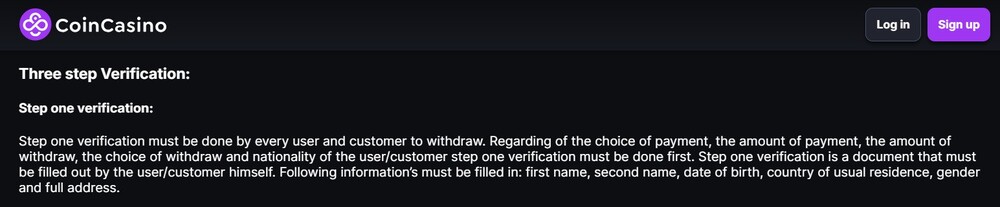
It also lists more extensive KYC checks, including passport, ID card, or driving licence images, a selfie, proof of address, and additional checks where needed.
The source-of-funds wording is even more important. CoinCasino says deposits over €5,000 can trigger a source-of-wealth review, and the account can be frozen if that amount is reached in a single transaction or across multiple transactions.
That doesn’t mean every small crypto user gets hit with full ID checks straight away. It does mean the “no KYC” label has limits. CoinCasino may be quick at signup, but the AML policy gives it plenty of room to ask questions when deposits, withdrawals, region risk or account behaviour trigger a review.
Betpanda: More Flexible, But Still Not Guaranteed
Betpanda has a stronger no KYC reputation than many crypto casinos because the signup flow is light, and some reviews report successful withdrawals without documents.
That doesn’t make it ID-proof.
A 2026 Betpanda KYC guide quotes the site’s terms as saying Betpanda reserves the right to verify your identity at any time, lock your account, or prevent withdrawals while checks are completed. The official terms page was not easy to parse cleanly through our web tool, so this is one I’d manually recheck in-browser before publishing with a hard claim.
That caveat matters.
Betpanda may well be fine for small, ordinary crypto play. But without a clear public threshold, you’re trusting the casino’s risk system to stay quiet. If it doesn’t, the no KYC label stops being the main story.
BC.Game and Stake Show Where the Market is Heading
BC.Game and Stake are useful examples because both are major crypto gambling names, but neither should be treated as a pure no KYC casino in 2026.
BC.Game’s own white paper says it can request KYC documents at any time to verify your identity and location, and that service or payment can be restricted until verification is complete.
Stake is even clearer. Its terms state that it can request KYC documents at any time, restrict payments or withdrawals until identity is verified, and conduct additional KYC checks for any withdrawal.
That doesn’t mean either site is doing anything unusual by the standards of gambling. It means crypto casino marketing has moved faster than the compliance language.
The front end says speed. The terms say control.
Why This Feels Worse Than Normal KYC
UK-licensed casinos are annoying with checks, but at least the model is clearer. UKGC rules require remote operators to verify identity before you gamble, including name, address, and date of birth. The regulator also says a gambling business can’t demand age and identity proof as a condition of withdrawal if it could have asked earlier.
No KYC crypto casinos flip that around.
They reduce friction early, then reserve the right to add it later. That feels better when you’re depositing. It can feel much worse when you’re trying to cash out.
The risk isn’t just “KYC exists.” The risk is timing.
What Triggers ID Checks at No KYC Casinos?
The exact triggers vary by site, but the usual red flags are easy to spot:
- Large withdrawals: A £50 crypto cashout and a five-figure win won’t always be treated the same.
- Repeated withdrawals: Several fast withdrawals can look different from one normal cashout.
- Bonus play: Bonus abuse reviews often sit close to withdrawal checks.
- Wallet risk: Deposits from flagged wallets, mixers, exchanges, or restricted sources can create AML friction.
- Location issues: VPN use, restricted countries, and mismatched login patterns can lead to account reviews.
- Multiple accounts: Crypto sites still care about linked accounts, shared devices, and repeated details.
- Source-of-funds checks: Bigger activity can trigger questions about where the money came from.
Don’t try to “game” these checks. If a site asks for ID and you can’t or won’t provide it, the withdrawal can stall. Fake details, borrowed documents, and VPN tricks can make the account problem worse.
The Offshore Licensing Problem
Many no-KYC casinos operate outside stricter gambling markets. That can mean more crypto options, fewer upfront checks, and bigger bonuses.
It also means less help if something goes wrong.
Anjouan has become a popular offshore licensing route, but it has attracted serious scrutiny. A 2026 Le Monde investigation described the Comoros/Anjouan casino setup as opaque and linked it to weak oversight, fake regulatory structures, and poor player protection.
That doesn’t automatically make every Anjouan-linked casino a scam. It does mean you should treat the license as a weaker trust signal than a stricter domestic license.
How to Read a No KYC Casino Claim
The useful move is to split the claim into three parts:
| Claim | What to check |
|---|---|
| No KYC signup | Can you register and deposit without ID? |
| No KYC withdrawals | Does the site process withdrawals without documents, or only below certain limits? |
| No KYC in all cases | Does the site reserve the right to ask for ID at any time? Most do. |
The third line is where most “anonymous casino” claims fall apart.
A site can still be fast. It can still be useful. It can still suit low-stakes crypto play.
But if the terms allow ID checks at withdrawal, it isn’t truly no KYC. It’s conditional KYC.
Betfinder Take
No KYC crypto casinos are not all fake. Some do offer quick sign-up, crypto deposits, and fast cashouts for ordinary play.
But “no KYC” is often a front-door promise. The back door still has checks.
CoinCasino’s own AML wording makes the no KYC label look too generous. Betpanda looks lighter, but still keeps discretion around identity checks. BC.Game and Stake show the wider trend: even crypto-first operators keep KYC powers in the terms.
The practical rule is simple: don’t judge a no KYC casino by the signup form. Judge it by the withdrawal policy.
If the site can ask for ID when you win, the privacy claim has a limit. And that limit usually appears when you most want the money out.