Prediction markets are no longer just for elections, crypto traders and politics junkies. The 2026 World Cup is turning them into a live rival for sportsbooks.
A June 2026 SEON survey found that prediction markets were the second most popular betting channel among U.S. adults planning to bet on the World Cup. Licensed betting apps still led at 29%, but prediction markets were next at 19%, ahead of social casinos, crypto platforms and offshore sites.
Among Millennials, the gap was tiny: 38% said they planned to use licensed betting apps, while 36% planned to use prediction markets.
That should make sportsbooks nervous. It should also make bettors careful.
Why Prediction Markets Are Suddenly a World Cup Story
Prediction markets turn betting-style outcomes into tradable contracts. Instead of backing France at fixed sportsbook odds, you might buy “Yes” shares on France winning the World Cup. If the contract settles yes, it pays out at $1. If not, it goes to zero.
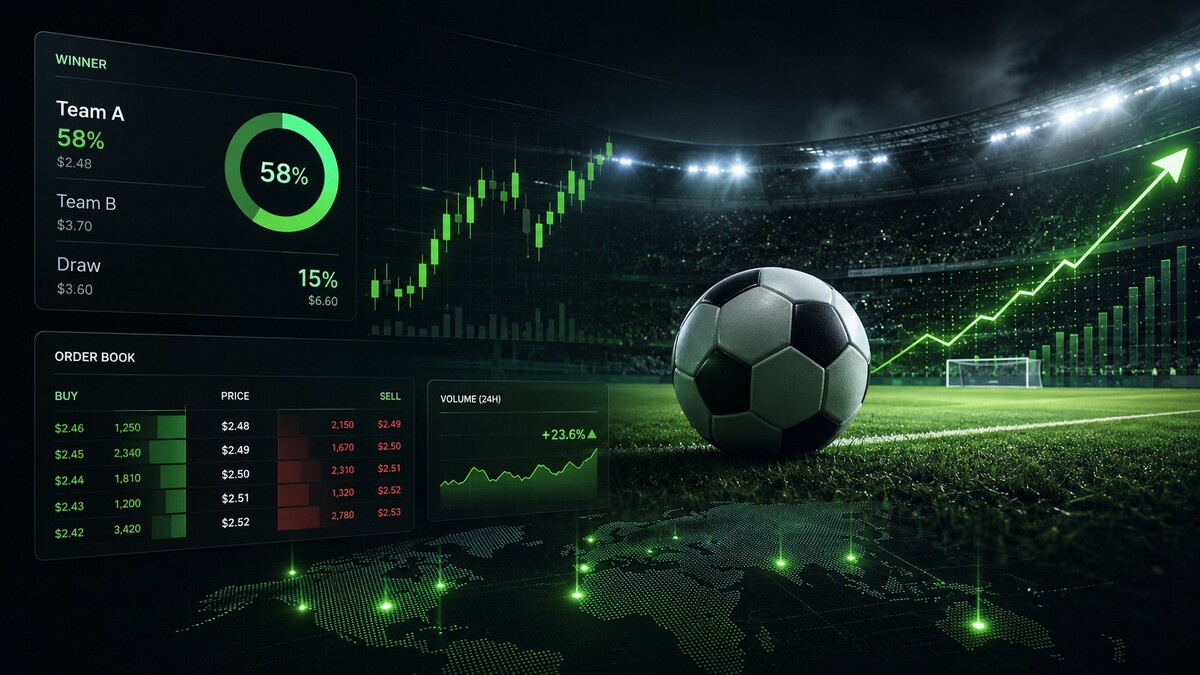
The price acts like an implied probability. A contract trading at 30 cents roughly suggests a 30% market view.
That’s the appeal. It feels cleaner than fractional odds, updates quickly and can be easier to read if you think in probabilities. For a huge event like the World Cup, that makes prediction markets look like a natural fit.
Polymarket already lists live World Cup markets covering tournament outcomes, continent-based markets and player props. Its World Cup prediction page says it has 20 active markets and more than $6.0m in trading volume.
That sounds big.
The catch? Volume is not the same as useful liquidity.
Volume Looks Good, But Liquidity Is the Number to Watch
World Cup prediction markets can show huge headline trading numbers, especially on outright winner markets. That doesn’t mean every market is easy to enter, exit or price properly.
Liquidity is the useful number.
A market can have a large historical volume figure but still be thin at the price you want. If the order book is shallow, your bet-sized trade can move the price against you. That matters if you’re trying to back a niche outcome, trade in-play or exit a position before the market settles.
Sportsbooks hide this problem differently. They quote a price, then control stakes through limits, account restrictions or price moves. Prediction markets show more of the mechanics, but that doesn’t mean the trade is better.
For World Cup bettors, the question is not “which platform has the smartest crowd?” It’s simpler:
Can you actually get the price you want for the stake you want? If not, the displayed probability is more signal than betting opportunity.
Liquidity isn’t the only structural risk either. Our look at Polymarket’s banking and regulatory risk shows how payment infrastructure and regulatory uncertainty can matter away from the trading screen too.
Sportsbooks Still Have the Easier Product
Prediction markets have one clear advantage: they make probability visible. A 27-cent contract is easier to understand than a messy fractional price if you’re comparing outcomes quickly.
Sportsbooks still win on convenience.
Most football bettors already understand match odds, goals markets, bet builders, each-way-style tournament markets and free bet offers. They also expect cash out, acca boosts, bet credits and in-play markets built around the match rather than around trading.
Prediction markets ask you to think differently. You’re not just picking a winner. You’re buying and selling a contract, often with the option to trade out before settlement.
That can suit sharper bettors. It can also trip up casual users who treat the displayed percentage like a normal bookmaker price.
A 40% market price is not automatically value. It only matters if your own probability is higher than the market’s, after fees, spread, liquidity and settlement rules.
The World Cup Is Perfect for Probability Markets
The World Cup gives prediction markets three things they love:
- Long-running narratives: injuries, squad news, group-stage results and bracket paths change prices for weeks.
- Simple headline outcomes: winner, top scorer, group winner and knockout progression all convert neatly into yes/no style markets.
- Constant social attention: every upset, VAR call and injury rumour can move prices.
That last point matters. Prediction markets can become part of the news cycle, not just a place to bet.
If a team drifts from 18% to 12% after a poor group-stage draw, that price move can get shared like a headline. It looks like the market has spoken.
Sometimes it has. Sometimes it’s just thin liquidity, overreaction or social media chasing the same move.
That’s the bettor’s problem. Prediction markets can be useful signals, but they’re not magic.
The Best Use May Be Price Checking, Not Betting
For many World Cup bettors, prediction markets may be most useful as a comparison tool.
If a sportsbook price implies 20% and a prediction market sits near 14%, that difference is worth checking. It doesn’t mean the sportsbook is wrong, but it gives you a reason to look closer.
The useful checks are:
- Implied probability: does the sportsbook price look shorter or bigger than the contract price?
- Liquidity: is there enough money at the displayed price?
- Rules: how exactly does the market settle?
- Timing: has the market moved because of news, team sheets or social hype?
- Exit option: can you trade out later, or are you stuck until settlement?
This is where prediction markets become interesting for bettors who already line shop. They add another price source.
Not always a better one. Another one.
The Risk: Betting Hype Disguised as Market Wisdom
Prediction markets often market themselves as cleaner, smarter and more transparent than polls or punditry. There is some truth in that. Real money can sharpen opinions.
But the “wisdom of the crowd” line can be oversold.
Business Insider reported in June 2026 that Polymarket had used paid influencers to promote its odds, with some posts allegedly lacking clear disclosure. Polymarket told POLITICO that partnerships with creators were part of its standard business practices.
That matters because prediction market prices are increasingly shared like news. If social media pushes the idea that a market is an oracle, bettors may stop asking the boring but useful questions.
Who is trading? How much money is actually available? Is the price liquid? What are the settlement rules? Has hype moved the number?
Those questions matter more during a World Cup, when casual betting interest spikes and every market move can be clipped, posted and overinterpreted.
Betfinder Take
Prediction markets will be part of the 2026 World Cup betting conversation. That doesn’t mean they’ll replace sportsbooks.
The better view is to treat them as a new layer of pricing. They can help you read market sentiment, spot probability gaps and track live reactions to team news. They’re especially useful if you already think in percentages rather than odds.
Just don’t confuse a clean-looking percentage with value.
For World Cup betting, the edge still comes from the same old places: price, timing, rules and discipline. Prediction markets change the wrapper. They don’t remove the work.
References
- SEON World Cup Betting Survey (markets.businessinsider.com)
- World Cup Predictions & Real-Time Odds (polymarket.com)
- World Cup Betting Competition Intensifies Between Sportsbooks and Prediction Markets (sportsbusinessjournal.com)
- How Paid Influencers Hype Polymarket’s Odds (businessinsider.com)