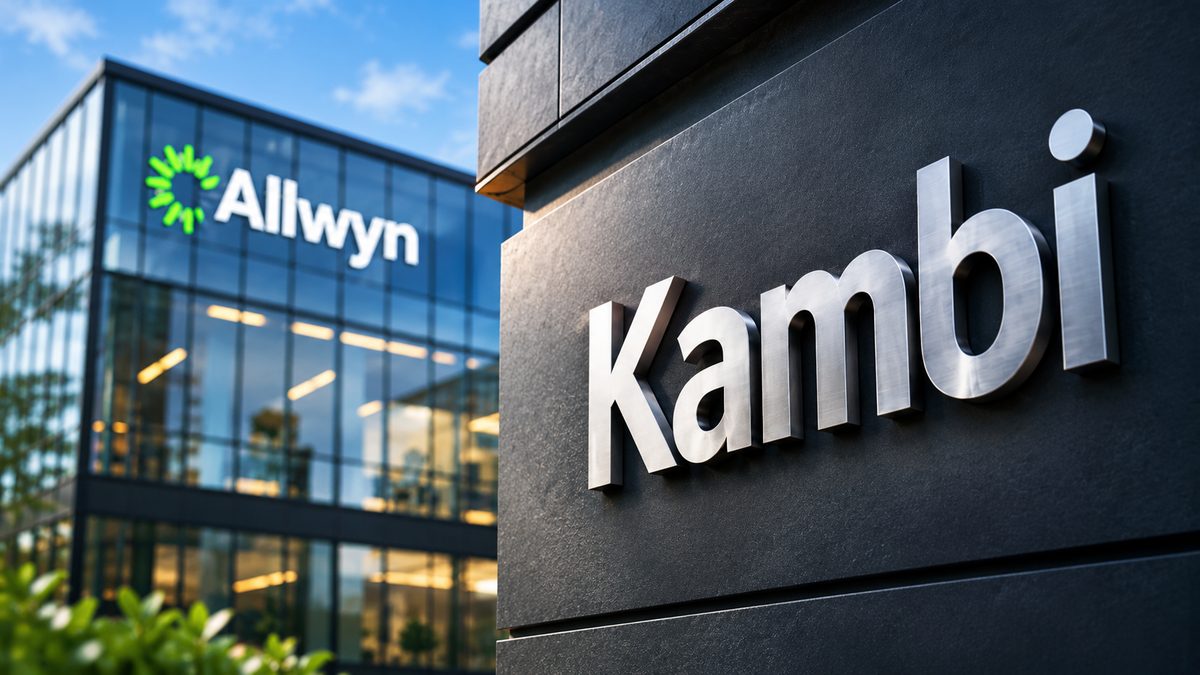
Allwyn will retain Kambi’s trading and risk management services under a separate long-term agreement. However, the company also plans to build more of its own trading, pricing and risk-management capabilities as the platform develops.
Announced on 10 November 2026, the deal gives Allwyn a permanent, global licence to Kambi’s sportsbook source code. Rather than building a new platform from scratch, Allwyn will adapt existing technology to support its betting brands across multiple markets.
The arrangement also raises an interesting question for the wider industry: how much control should bookmakers have over the technology that powers their odds?
What Is Allwyn Buying From Kambi?
According to Allwyn’s official announcement, the group will pay €50 million over three years to 2029 for the source-code licensing agreement and associated services. Kambi expects the agreements to contribute €45 million to €50 million in operating profit between 2027 and 2031.
Under the deal:
- Allwyn receives a perpetual global licence to Kambi’s sportsbook source code.
- Its betting brands will move towards a common technology platform.
- Kambi will provide development support during the transition.
- A dedicated Kambi team will eventually transfer to Allwyn.
- Kambi will continue supplying trading and risk management services under a separate long-term agreement.
For Kambi, the agreements are expected to contribute €45 million to €50 million in operating profit between 2027 and 2031.
Allwyn, meanwhile, reported more than €800 million in sports betting gross gaming revenue for 2025, giving it considerable scale to justify the investment.
Why Do Bookmakers Want Their Own Technology?
Controlling the sportsbook platform gives an operator more freedom to decide which products to build, how quickly to introduce new features and how to adapt its services for different countries.
Many bookmakers rely on external technology suppliers for substantial parts of their betting operations. That can reduce development costs, but it also limits how independently they can change their products.
Allwyn’s agreement offers a middle route. It gets established sportsbook technology while taking responsibility for future development.
It’s an approach that could appeal to other large gambling groups, although Kambi chief executive Werner Becher told iGaming Business that similar arrangements would be considered selectively rather than becoming a routine part of its business.
Could the Deal Change Betting Odds or Margins?
Potentially, but there is no evidence that Allwyn’s agreement will immediately alter the odds available to customers.
The distinction between sportsbook technology and trading is important.
A sportsbook platform handles functions such as displaying markets, processing bets and supporting account operations. Trading teams and pricing systems determine odds, manage liabilities and adjust markets as information changes.
Allwyn is bringing its platform development in-house while retaining Kambi’s trading and risk management services.
That means the company isn’t simply taking over every aspect of its odds-setting operation.
Over time, greater control could allow Allwyn to experiment with market availability, bet builders, live betting features and other parts of the sportsbook experience.
Whether that results in more competitive odds is another matter. Owning the technology doesn’t automatically mean a bookmaker will offer lower margins.
For anyone comparing prices, the same principle still applies: the bookmaker offering the strongest technology isn’t necessarily offering the best odds.
Betfinder’s Odds Scanner and Dropping Odds Tracker provide separate ways to examine available sportsbook prices and market movements.
Why Kambi Is Still Part of the Picture
Kambi hasn’t simply sold its technology and walked away.
The supplier will continue providing trading services, including pricing and risk management capabilities. It will also support Allwyn’s transition to the new platform.
Kambi’s existing sportsbook technology serves partners across more than 100 jurisdictions, and its commercial model continues to include supplying technology and odds services to other operators.
This arrangement allows Allwyn to take greater control without losing access to the trading expertise behind the existing product.
For Kambi, it opens another way to generate revenue from technology it has spent more than 15 years developing.
Betfinder Take: Technology Ownership Is Not a Betting Edge
The Allwyn-Kambi agreement shows how major gambling groups are looking beyond traditional supplier relationships to gain more control over their products.
For customers, that could eventually mean more distinctive betting apps, different market offerings and faster product development.
The real test will be whether Allwyn uses that control to deliver better betting products.
More markets, faster development and a better interface would all be welcome. But for anyone comparing bookmakers, the price remains the deciding factor. Owning the technology is no substitute for offering competitive odds.