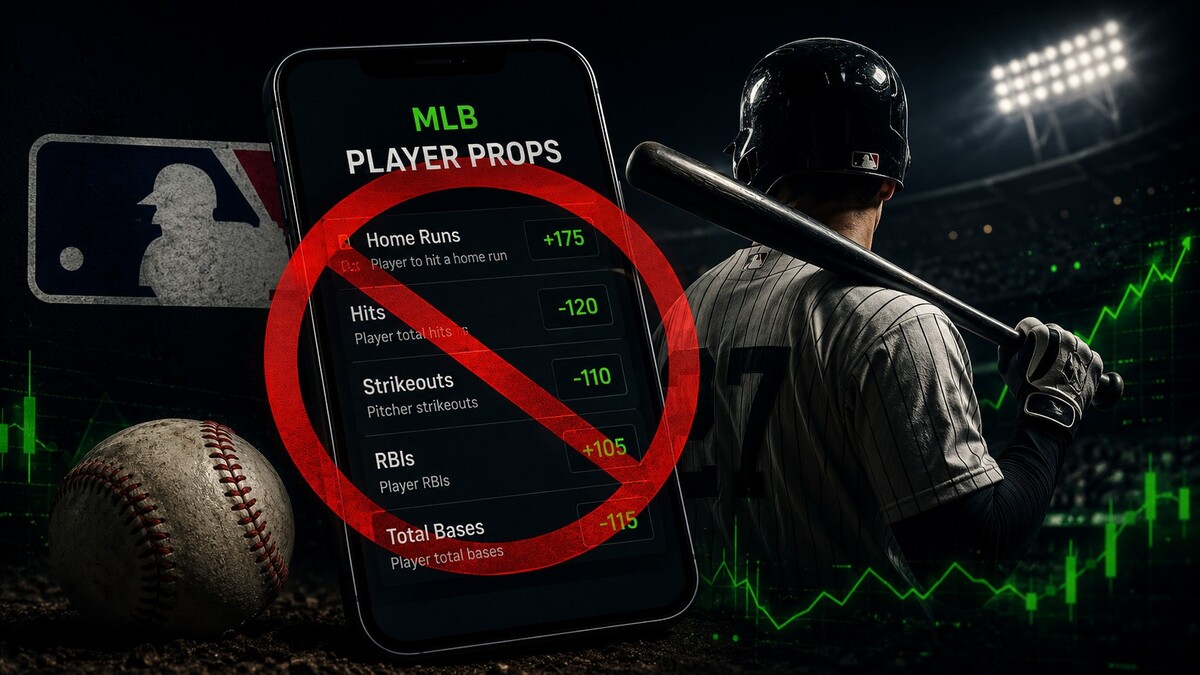
The MLBPA has reportedly asked Major League Baseball to pursue a ban on individual player prop bets as part of the latest collective bargaining talks.
Not all baseball betting would disappear. Sides, totals, futures and team markets could still exist. The target is more specific: bets tied to one player’s performance, including home runs, hits, strikeouts, RBIs, pitch-level markets and in-game stat outcomes.
For sportsbooks, that’s the awkward bit. Player props are no longer side dishes. They’re the fuel for same-game parlays, bet-builder promos, in-play nudges and half the daily MLB betting content you see online.
If MLB moves against them, it would test a question leagues have avoided for years:
How much betting revenue is worth the cost when the bet is tied directly to a player’s name?
What Happened
ESPN reported that the MLB Players Association proposed a ban on individual player prop bets during CBA talks with MLB.
The proposal reportedly covers player props placed before or during games. That would include common MLB markets such as:
| Market | Why it matters |
|---|---|
| Pitcher strikeouts | One of the most popular daily MLB prop markets |
| Batter hits | Simple, easy to price, easy to promote |
| Home runs | Big public appeal, especially around star hitters |
| RBIs and runs | Often used in same-game parlays |
| Pitch-level bets | Higher integrity risk because one player can decide the event |
| Live player props | Fast-moving and harder for casual users to price properly |
The current MLB collective bargaining agreement expires on December 1, 2026, so this is part of a much wider labour fight. Salary caps, contract length, revenue sharing and draft rules are the bigger baseball issues.
But for betting, the player prop proposal is the one to watch.
Why Player Props Are The Problem
Player props attach money to a name.
If you bet an MLB side and the team loses, blame gets spread around. Bad bullpen. Poor defence. Weak lineup. Bad beat. Fine.
If you bet a pitcher over 6.5 strikeouts and he finishes on six, the anger goes straight to one person. Same with a hitter who goes 0-for-4, a closer who misses the strike zone, or a player who gets pulled early.
That direct link is what makes props great for sportsbooks and ugly for players.
They are easy to understand, quick to promote and perfect for app betting. You don’t need to price the whole game. You can bet Aaron Judge to homer, Paul Skenes to hit a strikeout line, or a leadoff hitter to record a hit.
The trade-off? Every missed line creates a target.
The Sportsbook Catch
Sportsbooks do not push player props by accident.
They work beautifully inside the modern betting app. They are simple enough for casual users, deep enough for sharper baseball fans, and ideal for same-game parlays. A moneyline bet is one selection. A player-prop card can turn into five.
That matters because reports around the MLBPA proposal put player props at around 20% to 30% of wagers on a game.
Even if that number varies by operator, the direction is obvious. Player props aren’t a novelty market anymore. They are a core part of how US sportsbooks keep people betting across a long baseball season.
A full ban would hit:
- Same-game parlays, because player legs are often the interesting part
- Promos and odds boosts, especially star-player specials
- Live betting menus, where individual stat markets keep games active
- DFS-style products, if the push reaches beyond sportsbooks
- Prediction markets, if player performance contracts keep growing
That’s why this is bigger than one CBA clause. It cuts into how betting apps are built.
MLB Already Knows Some Props Are Riskier Than Others
MLB has already acted on the most dangerous version of the problem: pitch-level betting.
After two Cleveland Guardians pitchers were charged in a federal sports betting case in November 2025, MLB and its sportsbook partners announced limits on pitch-level markets. Those markets were capped at $200 and removed from parlays.
That distinction matters.
A pitcher’s season strikeout total is one thing. A live bet on whether the next pitch is a ball or a strike is very different. One is built across a larger performance sample. The other can be decided by a single action that may not even affect the final score.
That is why micro-markets are so uncomfortable for leagues.
They create a tiny, bettable event. One player can influence it. The game can carry on as normal. The betting result still lands.
For MLB, that is the nightmare shape.
A Full Ban Would Not Stop Baseball Betting
The obvious pushback from the betting industry is simple: banning a legal market does not make the demand vanish.
If licensed sportsbooks lose player props, some people will just bet sides and totals. Some will move to team props. Some will stop betting on MLB as often.
Others will look elsewhere.
That is the uncomfortable bit for regulators and leagues. Legal sportsbooks are supervised, taxed and tied into integrity monitoring systems. Offshore books and illegal operators aren’t working to the same rules.
So MLB has three bad choices:
| Option | Upside | Problem |
|---|---|---|
| Keep player props as they are | Sportsbooks keep popular markets | Players keep taking the heat |
| Ban all individual props | Cleaner player-protection message | Some betting demand may move offshore |
| Restrict the riskiest props | More realistic compromise | Still leaves players exposed on common stat markets |
The third option feels most likely.
What A Compromise Could Look Like
A complete MLB player prop ban would be a huge move. A tighter rulebook feels easier to sell.
Possible compromises include:
- Ban pitch-level micro-bets completely
- Cap stakes on individual player props
- Remove player props from same-game parlays
- Limit live player props during games
- Ban props on injured or returning players
- Force clearer sportsbook reporting on harassment
- Suspend accounts tied to threats or abuse
That last point is already moving.
Fanatics Sportsbook announced a Bad Actor Program on June 25, 2026, with IC360 and Signify Group. The idea is to identify people who threaten or abuse athletes, coaches or officials online, then restrict or terminate sportsbook accounts.
That is a useful step. It also shows the problem has gone past “people say stupid things online.”
Sportsbooks now have to treat player abuse as a product-risk issue.
What This Means If You Bet MLB
If you bet on MLB, the short-term answer is simple: nothing changes yet.
This is a proposal inside CBA talks, not a rule already in force. You can still find MLB player props at legal sportsbooks where they are offered.
The longer-term picture is less settled.
If the union keeps pressing this, MLB props could become less open, less parlay-friendly, or more restricted in certain states. Pitch-level markets have already been cut back. The next battle may be standard player stats, especially pitcher strikeouts and hitter props.
For regular MLB betting, sides and totals would probably become more important again. Team totals, first-five innings markets, and alternate run lines could see more attention if individual props are trimmed.
That would not be terrible for smarter baseball betting.
Player props are fun, but they are also some of the most heavily promoted markets on the app. They invite impulse bets, same-game parlay stacking and “one player ruined my slip” thinking.
Not ideal.
The Real Issue Is Product Design
This debate is not just about angry messages after losing bets.
It’s about what sportsbooks chose to make easy.
Betting apps have trained users to think in player-led outcomes. One player. One stat. One quick tap. Then another. Then a parlay.
That model creates engagement, but it also makes individual athletes feel personally responsible for someone else’s lost stake.
That’s the line the MLBPA is now testing.
The players are not saying baseball betting has to disappear. They are saying their individual performances should not be packaged into endless, parlay-friendly markets that turn them into betting targets every night.
It’s hard to argue that they have no point.
Betfinder Take
A full MLB player-prop ban would be messy, and sportsbooks would hate it.
But the pressure is not going away. MLB already accepted that pitch-level micro-bets carry extra integrity risk. The NCAA has been pushing against college player props for the same mix of harassment, inside information and spot-fixing concerns. Now the MLBPA is trying to pull professional baseball further in that direction.
The most likely outcome is not a clean yes or no.
Expect a fight over the middle ground: lower limits, fewer micro-markets, tighter parlay rules, harsher account action for abusive sportsbook customers, and more pressure on states to rethink which player props should be allowed.
The key number is not the strikeout line or the home run price.
It is how much of MLB betting volume sportsbooks are willing to lose before they admit some markets are more trouble than they are worth.