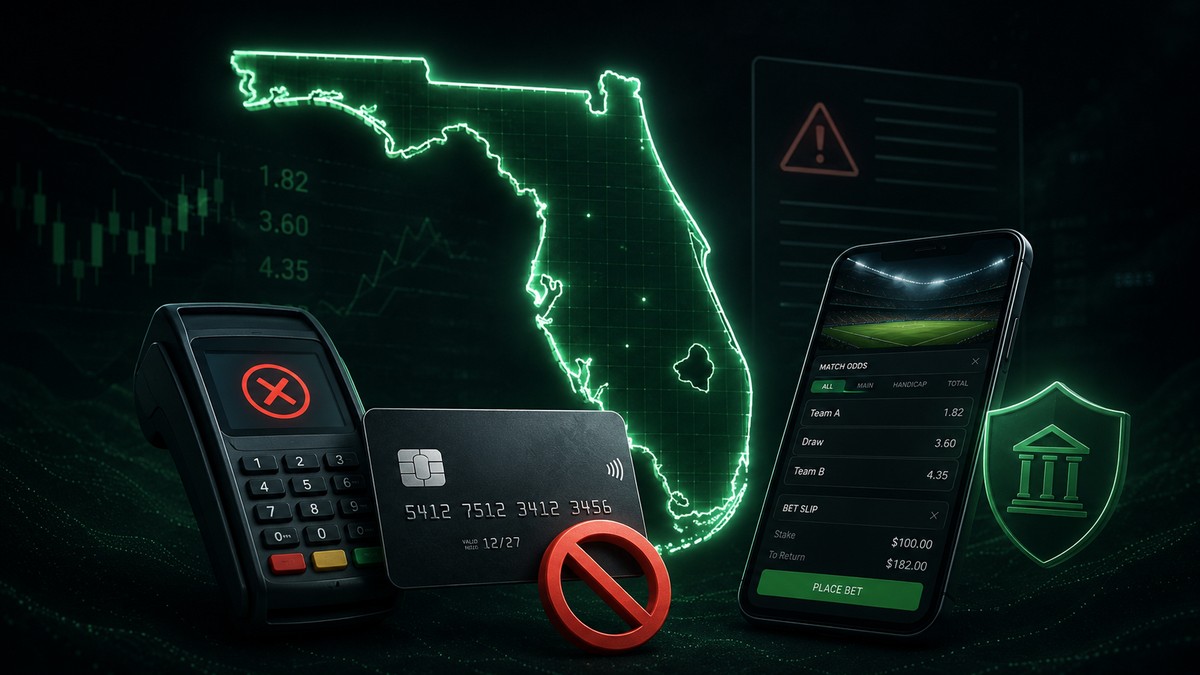
Florida is no longer only chasing offshore betting sites. It is now putting pressure on the companies that help move the money.
Attorney General James Uthmeier has warned major payment processors over transactions linked to unlicensed online gambling. Visa, Mastercard, and American Express were named in public comments, while a separate letter to Visa reportedly referenced offshore operators including Bovada, BetOnline, BetUS, XBet, BetNow, Lucky Rebel, and SportsBetting.
That matters because offshore betting does not run on odds alone. It runs on deposits, withdrawals, card networks, processors, merchant codes, and enough banking access to keep money moving.
If Florida can make that part harder, the practical effect could show up before any betting site fully leaves the market.
What Happened
On June 10, 2026, the Florida Attorney General’s Office announced results from a wider illegal gaming enforcement operation in Lee and Collier counties.
The operation led to 11 arrests, the seizure of 479 illegal machines, and the recovery of $294,150 in alleged illicit proceeds.
The bigger statewide number is more eye-catching. Since the start of 2026, Florida says it has seized 3,114 illegal gaming machines, recovered $1.7 million, and arrested 81 people linked to unlawful gambling activity.
Buried in that announcement was the line that makes this more interesting for online betting: the Attorney General also notified payment processors that helping illegal online gaming transactions may implicate Florida’s RICO Act.
That is the sharp edge of the story.
Florida is not just saying offshore gambling sites are a problem. It is telling payment firms that the money route itself may be part of the problem.
Why Payments Matter More Than Another Warning Letter
Offshore operators are used to legal pressure. Cease-and-desist letters to betting sites are not new, and Florida already sent shutdown demands to several overseas operators in 2025.
Payment pressure is different.
A sportsbook can ignore a state regulator more easily when it has no office, licence or local staff in that state. A payment processor has more to lose. It has banking partners, compliance teams, US exposure and reputational risk.
That is why the payment rail is often the softer target.
For anyone betting offshore, the possible effects are simple enough:
- Card deposits may fail more often
- Withdrawals may face more checks
- Some sites may push crypto harder
- Payment options may change without much warning
- Operators may become more selective about US traffic
None of that means every offshore betting account in Florida suddenly stops working. It does mean the friction can increase.
That is usually where regulation bites first.
Florida’s Betting Market Makes This Messier
Florida is an unusual sports betting state because legal online betting runs through Hard Rock Bet under the Seminole Tribe compact.
That gives Florida a cleaner enforcement argument than states with five, ten or twenty licensed books. The state can say there is one legal online sportsbook route, and everything outside that structure sits beyond the local framework.
For bettors, that creates a clear trade-off.
The regulated option has local oversight, geolocation, state-approved terms, and a direct complaint route. Offshore books may offer more promos, bigger limits in some markets, casino products, or crypto payments, but they do not sit inside the same Florida regulatory setup.
That difference is not academic. It affects what happens if a payment gets stuck, an account is closed, or a withdrawal is delayed.
The Real Target Is the Offshore Betting Business Model
The interesting part here is not whether Florida dislikes Bovada or BetOnline. We already knew where the state stood.
The interesting part is the method.
Offshore betting depends on being easy enough to use. If card deposits work, payouts arrive, and the app loads, many casual users will not think too hard about the legal plumbing underneath it.
Break the payments, and the product feels different.
A betting site can have strong odds and a slick mobile layout, but that matters less if deposits keep bouncing or withdrawals become awkward. For offshore operators, payment reliability is not just a back-office issue. It is the product.
That is why this Florida move is worth watching beyond one state.
If more regulators copy this approach, the pressure moves from the front door to the wiring behind the wall.
The Catch
There is still a lot we do not know.
A warning letter does not automatically mean Visa, Mastercard or American Express will block every transaction connected to offshore gambling. Payment routing can be messy, and gambling transactions do not always appear in a neat, obvious way.
Offshore operators also adapt. They can shift processors, add crypto options, change descriptors, lean on wallets, or make users jump through extra funding steps.
That is the cat-and-mouse game.
But the direction is clear: Florida wants to make unlicensed gambling harder to fund, not just harder to advertise or operate.
Betfinder Take
This is one of those stories where the boring bit is the important bit.
Payment processing rarely gets the same attention as odds boosts, sportsbook launches or flashy app features. But for real-world betting access, it matters more than almost anything.
If you use offshore books from strict US states, the number to watch is not just whether the site still accepts registrations. Watch the deposit page. Watch the withdrawal options. Watch whether cards quietly disappear and crypto gets pushed harder.
That is where the crackdown may show up first.