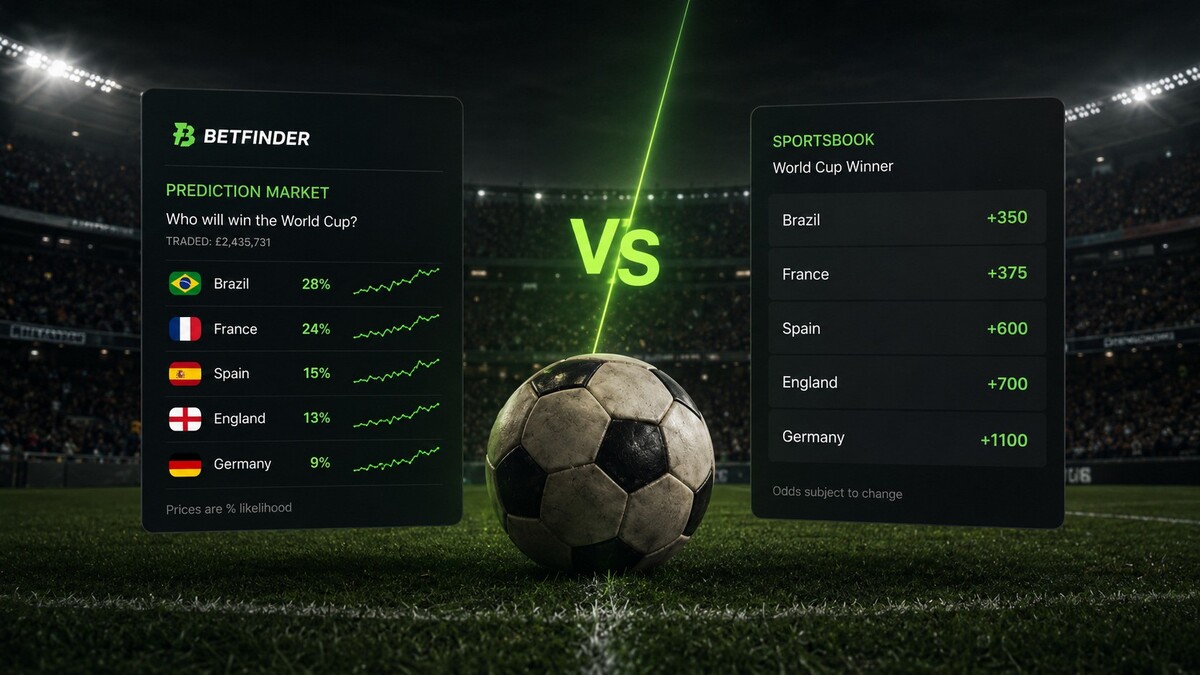
Prediction markets have arrived at the World Cup at exactly the wrong moment for traditional sportsbooks.
FIFA has named ADI Predictstreet as the Official Prediction Market Partner of the 2026 World Cup, FanDuel Predicts has expanded its event-contract product through Crypto.com, and Matchbook has launched World Cup prediction markets with ADI Predictstreet in the UK, Ireland, and Brazil.
That’s not a small side story. It’s a direct challenge to how football betting is packaged, priced, and sold during the biggest betting event on the planet.
What Actually Changed
ADI Predictstreet is now FIFA’s official prediction market partner for the 2026 World Cup.
The product is built around forecast-style contracts, where users take a position on what they think will happen. That could mean a team winning a match, progressing through the tournament, or landing a specific outcome.
The timing matters. ADI Predictstreet went live in June, just before the World Cup kicked off on June 11. The product is also linked to Fanatics Markets in the US and Matchbook’s World Cup prediction-market platform in the UK, Ireland, and Brazil.
FanDuel Predicts is moving at the same time. On June 9, FanDuel announced an expanded event-contract offering through Crypto.com and OG Prediction Markets, with new sports and entertainment contracts tied to the start of the World Cup.
So, this isn’t one company testing a niche product. Several operators are now trying to place prediction markets next to sports betting during football’s biggest month.
Why This Matters for Bettors
The pitch is simple: instead of placing a traditional bet with odds, you trade a yes/no outcome.
That makes prediction markets feel more like trading than betting. A contract price can also look like an implied probability, which some bettors may find easier to read than American, decimal, or fractional odds.
For example, a team trading at 40 cents roughly suggests a 40% chance. If the contract settles at $1, a winning trader gets the full payout. If it settles at $0, the position loses.
The idea is not hard to understand. The tricky bit is whether the price is any good.
Sportsbooks build margin into odds. Prediction markets have spreads, fees, liquidity issues, and settlement rules. Those costs can be less obvious, especially if the market looks clean on the screen.
A bad price is still a bad price, even if it’s shown as a percentage.
The Sportsbook Problem
Sportsbooks already expected the 2026 World Cup to be huge. H2 Gambling Capital has projected around $60 billion in legal global handle, helped by the 48-team format, 104 matches, and wider legal betting access since 2022.
Prediction markets now want a piece of that attention. The threat is not only volume. It’s product design.
Sportsbooks sell odds, boosts, bet builders, player props, and same-game parlays. Prediction markets sell a cleaner idea: buy yes, buy no, trade the outcome.
That can appeal if you already think in probabilities. It can also appeal if you don’t think of yourself as a sports bettor but are comfortable trading crypto, stocks, or event contracts.
For operators, that’s the bigger worry. Prediction markets don’t need to beat sportsbooks on every football market. They only need to win enough casual and trading-led attention around the biggest events.
The Regulatory Fight Is Far From Settled
The US is where the argument gets messy.
Prediction-market operators often frame sports event contracts as federally regulated products under the Commodity Futures Trading Commission (CFTC). Sports betting operators and state regulators tend to see the same activity as gambling by another route.
The CFTC is now trying to draw clearer lines. On June 10, it published a proposed rulemaking notice on event contracts involving listed activities. That came after an earlier March 2026 request for public comment on prediction markets.
That timing is awkward for everyone. The World Cup is already here, but the rulebook is still being written.
Kentucky has also become part of the wider fight. A coalition including Kalshi, Crypto.com, and Polymarket has sued to block the state’s new 14.25% tax on prediction markets.
So the market is growing, but the legal shape is still not settled.
That matters for bettors because product access, tax treatment, market rules, and dispute routes can all change.
The Fine Print Problem
Prediction markets can look cleaner than sportsbooks, but contract wording matters.
Traditional sportsbook rules can be annoying, but if you’re used to checking things like extra time, dead heat rules, voids, and settlement terms. Prediction markets introduce a different risk: the way the contract is defined and resolved.
If the wording is vague, two users can trade the same market with different assumptions about what counts as a winning outcome.
That’s not theoretical. Recent disputes over prediction-market settlement rules have already shown how costly ambiguity can be.
For World Cup betting markets, the details to watch are simple:
- Does extra time count?
- Do penalty shootouts count?
- What data source decides the settlement?
- Can the platform issue clarifications after trading starts?
- Are there fees on entry, exit, or settlement?
- Is there enough liquidity to get out at a fair price?
Those details matter more than the headline probability.
Where the Edge Might Be
Prediction markets could be useful where sportsbook prices are lazy, slow, or too public-driven.
World Cups are full of emotion. Host nations get overbet. Big-name teams shorten quickly. Star players attract money in goalscorer markets even when the price has already gone.
A liquid prediction market can sometimes expose that more clearly than a sportsbook line. If a team’s contract price drifts too far after one poor result, there may be a trade. If public money piles into a patriotic angle, the other side can become more interesting.
But that only works if there is enough liquidity and the settlement rules are clean.
Thin markets are dangerous. Wide spreads eat edge. A contract that looks like value at 38 cents may not be value if you can’t exit properly, or if the rules leave too much room for interpretation.
Betfinder Take
Prediction markets won’t replace World Cup betting in 2026. Sportsbooks still own the main habit: match odds, player props, live betting, bet builders, and bonus-led acquisition.
But prediction markets have moved from fringe talking point to live competitor.
FIFA’s ADI Predictstreet deal gives the category credibility. FanDuel and Crypto.com give it US reach. Matchbook gives its exchange heritage in mature betting markets.
For bettors, the useful angle is not whether prediction markets are “better” than sportsbooks. Sometimes they’ll be worse. Sometimes they’ll be cleaner. Sometimes they’ll just be another way to overpay for a popular outcome.
The smart move is to compare the contract price against the sportsbook price, then check fees, liquidity, and settlement terms before trading.
The product is new. The old rule still applies: price first, story second.
Sources
- ADI Predictstreet (FIFA)
- ADI Predictstreet named official prediction market partner of the FIFA World Cup 2026 (FIFA)
- ADI Predictstreet launches prediction market ahead of World Cup 2026 (iGaming Business)
- FanDuel Predicts to Expand Event Contract Offering Through Partnership With Crypto.com and OG Prediction Markets (Crypto.com)
- Matchbook launches World Cup prediction markets with ADI Predictstreet (Next Predict)
- CFTC Seeks Public Comment on Notice of Proposed Rulemaking Concerning Event Contracts Involving Enumerated Activities (CFTC)
- A coalition sues to block Kentucky’s new 14.25% prediction markets tax (Associated Press)