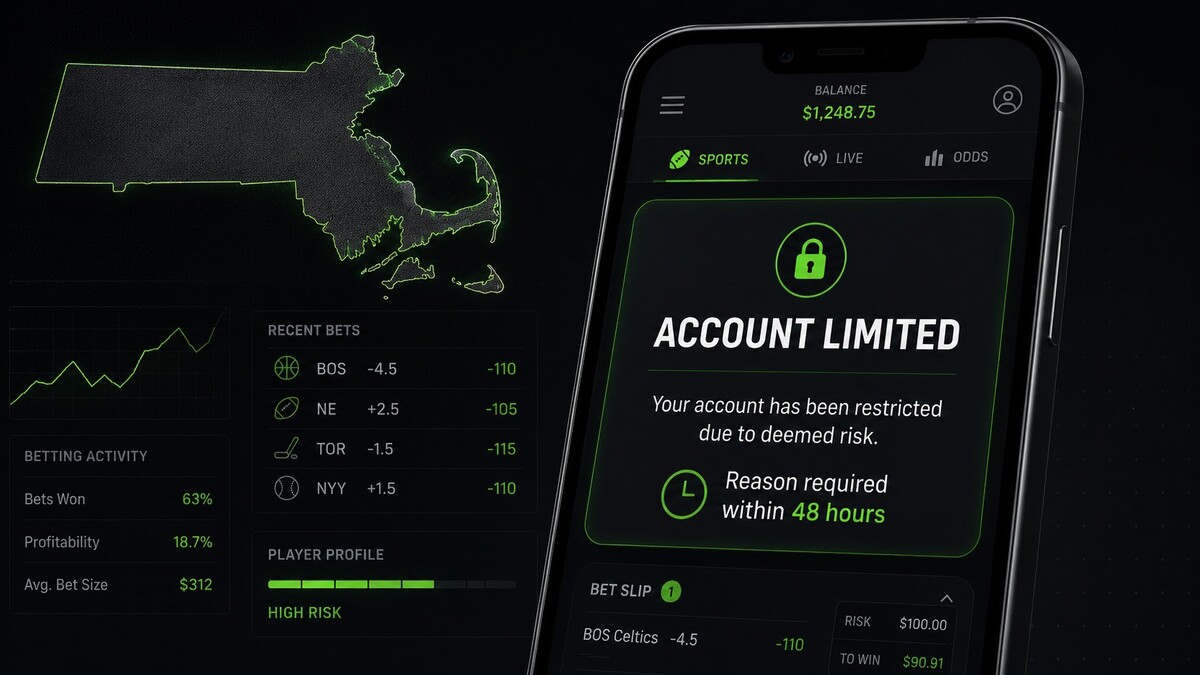
Massachusetts has forced sportsbooks to do something bettors have wanted for years: explain why an account has been limited.
The new rule took effect on June 1, 2026. Sportsbook operators in the state must now notify a customer within 48 hours when their betting activity is restricted, and the notice has to include a specific reason. A vague “business decision” line should no longer be enough.
That doesn’t mean limited accounts suddenly get their stakes back.
The useful bit is simpler: Massachusetts has made it harder to hide sportsbook limits.
What Changed in Massachusetts?
Massachusetts sportsbook operators must now notify affected customers when their accounts are limited, why, and which markets are affected.
The Massachusetts Gaming Commission moved to amend bill 205 CMR 238.30, covering acceptance of sports wagers. The rulemaking notice said operators must have procedures to provide timely notice when betting activity has been limited, with a specific explanation for the limit and identification of the affected market or markets.
According to Sports Betting Dime, the Commission approved the details by a 5-0 vote and set the notice start date for June 1, 2026. The same report said the rule applies to customers who were already limited before that date, to new limits added after that date, and to limits that follow a customer from another state into Massachusetts.
CBS Sports also reported that operators must provide a specific, personalized explanation, not a boilerplate response.
Why This Matters for Bettors
Account limits are among the least clear aspects of online sports betting.
You might get $500 on one market, then suddenly only get $4.37 on the same type of bet a week later. In some cases, the site won’t tell you whether you’ve been limited because of winning, betting behavior, bonus use, latency, arbing, market selection, or something else entirely.
Massachusetts doesn’t fix that problem. Not fully.
It does create a paper trail.
That matters if you’re betting seriously, because the reason given by the sportsbook can tell you a lot about how your account has been profiled. CBS reported that some notices already shared by bettors have used phrases such as “perceived market inefficiency,” “live market latency exploitation,” and “structured wagering.”
In plain English, that points to accounts being flagged for things like:
- beating soft prices
- getting ahead of live-market moves
- betting in patterns the operator sees as structured
- taking advantage of slow or mispriced markets
- using markets the book doesn’t want sharp action on
That’s the bit sharp bettors will care about.
Not the notice itself. The wording.
The Catch: Limits Are Still Allowed
The Massachusetts rule does not ban sportsbooks from limiting customers.
A sportsbook can still decide it doesn’t want your action at full stake. It can still manage risk. It can still cut your max bet on certain markets.
The difference is that it now has to explain the decision in Massachusetts.
That’s useful, but it’s not the same as fair pricing. A sportsbook telling you “we limited your in-play bets because of latency concerns” is better than silence, but it still leaves you with the limit.
This is disclosure, not stake protection.
Why Sportsbooks Limit Accounts
Sportsbooks say account limits are part of risk management.
At a Massachusetts Gaming Commission discussion in September 2024, operators said they look at betting patterns, bonus abuse, irregular behavior, and accounts trying to create or exploit an edge. iGaming Business reported that operators also discussed arbitrage and courtsiding as examples of activity that can trigger concern.
That argument isn’t hard to understand. A bookmaker doesn’t want to take endless sharp money into stale prices, slow live feeds, or badly modeled niche markets.
The problem is the other side of the bargain.
Sportsbooks market betting as a fair contest against the odds. They promote winning. They run boosts, bet builders, parlays, VIP offers, and profit-style messaging. Then, when an account shows it can beat certain markets, the same account can be restricted.
That’s the uncomfortable bit.
The 0.64% Number Is Doing Heavy Work
Operators argue that only a tiny share of accounts are limited.
CBS Sports reported that operator-provided data showed 0.64% of accounts had limitations. The same report said the data showed a direct link between bettors winning more than average and whether their account had restrictions.
That number sounds tiny. It’s probably tiny compared to the full mass of casual accounts.
But it’s not tiny if you only care about people who shop lines, beat closers, take early prices, or regularly find weak markets.
Most casual bettors will never notice this rule. Serious bettors will.
What to Watch in the Notices
The exact wording of the notices is now the story.
If operators give clear reasons, the rule could show which behaviors trigger limits most often. If they fall back on vague phrases, the Massachusetts Gaming Commission has a fresh enforcement question.
The key details to watch are:
- Reason given: Does it explain the actual behavior, or just dress up a generic risk decision?
- Markets affected: Is the limit on all sports, live betting, player props, promos, or one specific market?
- Scope: Is the account restricted everywhere, or only in Massachusetts?
- Repeat notices: Does the sportsbook send a new notice when a fresh restriction is added?
- Language patterns: Do different operators use the same phrases for sharp action?
For bettors, the wording may become a rough map of what each operator fears most.
Betfinder Take
Massachusetts hasn’t ended account limiting. It has made the quiet part slightly louder.
Sportsbooks can still restrict customers who beat prices, attack weak markets, or show betting patterns the risk team doesn’t like. But in Massachusetts, they now have to put a reason in writing.
That’s not a win in the full sense. It’s a crack in the black box.
For anyone who bets beyond weekend accas and boosted parlays, that crack is worth watching.