IEM Cologne Major 2026 is not the kind of CS2 event where you can judge every bet from headline form alone.
The tournament runs from 2 to 21 June in Cologne, with 32 teams competing for a $1.25m prize pool. By Stage 3, the betting picture becomes more interesting, as the Swiss format is played in best-of-three matches, with the top eight teams advancing to a single-elimination playoff bracket.
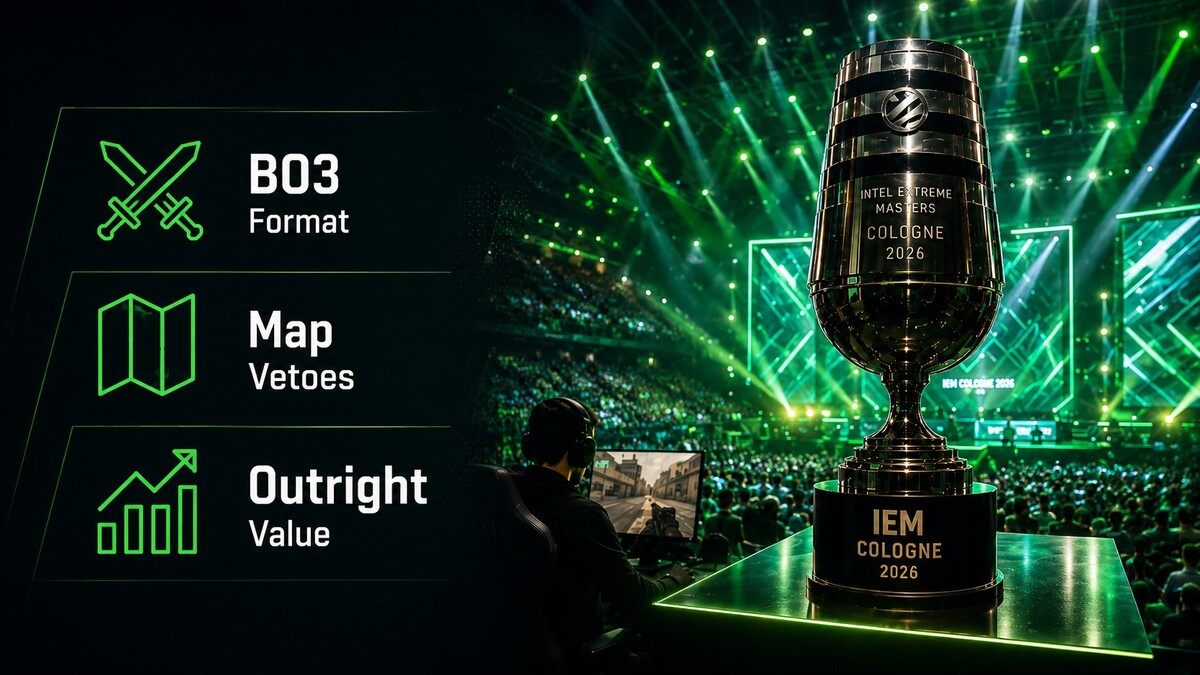
That matters for bettors. BO3 Counter-Strike gives stronger teams more time to recover, but it also makes map pools, vetoes, fatigue, and role depth harder to ignore.
What’s Happening at IEM Cologne Major 2026
IEM Cologne Major 2026 is one of the biggest CS2 events of the year, and the event has already produced enough volatility to make outright and match betting trickier than the seedings suggest.
The first three stages feed teams forward through Swiss play. The final eight then move into a single-elimination playoff bracket, with a best-of-five grand final.
Stage 3 is where the market usually gets sharper. The weaker teams are mostly gone. The public favs are shorter. The price gaps between the best sides and dangerous outsiders can still be wide, but the matchups are far less forgiving.
That’s where BO3 CS2 betting becomes useful.
A best-of-one can punish one poor pistol round, one slow start, or one bad veto. A best-of-three gives you more evidence. It also gives the better-prepared team more ways to win.
Why BO3 Matters for Bettors
BO3 matches reduce some of the random noise, but they don’t remove upset risk.
A moneyline favorite in BO3 has more margin for error. They can drop a close opener, reset, and still win the series. That makes elite teams more reliable than they would be in BO1 markets.
The catch? Prices usually know that.
Short odds on top teams can look safe, but the true value depends on how the maps line up. If the underdog has one strong pick and can survive the decider, the handicap or map market may be more interesting than the match winner.
For bettors, BO3 shifts the question from “who is better?” to “how many maps does this team have a real edge on?”
That’s a much better question.
Map Vetoes Matter More Than Outright Form
Map vetoes are one of the cleanest ways to find value in CS2 betting.
A team can be in better form overall and still land in an awkward map pool. Another team can look weaker on rankings, but have a clear route if its best map survives the ban phase.
That matters even more at Cologne because the current CS2 map pool includes Ancient, Anubis, Dust2, Inferno, Mirage, Nuke, and Overpass.
Before betting a BO3, check three things:
- First pick strength: Does the team have a map it can win even as an underdog?
- Permaban clash: Does one team’s usual ban remove the other team’s best weapon?
- Decider comfort: If the series reaches map three, which team has shown more depth?
This is where lazy favorite betting gets expensive. A team with a stronger name, higher ranking, and better outright price can still be a poor bet if the veto gives the opponent one free swing and a playable decider.
Why Underdogs Can Still Bite
BO3 does not kill underdog value. It just changes where you look for it.
At Stage 3, 9z clearly showed it by beating Vitality 2-1 in a Swiss round match. FURIA also made noise with wins over MOUZ and BetBoom, proving again that form, confidence, and map comfort can move faster than the market.
These are not random pub-team upsets. They’re reminders that CS2 is still fragile at the top when the maps don’t fall neatly.
For underdogs, the better angles are usually:
- +1.5 maps if they have one strong pick
- Map winner if the veto gives them their comfort map
- Live betting after pistol rounds if the pre-match price overreacts
- Round handicap when the underdog is good enough to keep maps close
The match winner is not always the smartest way in. Sometimes the value is in the underdog, making the favorite work.
Outright Market: Fav or Path?
Outright betting at a Major is not just about picking the best team.
Path matters. Draw matters. Recovery time matters. So does whether a team has already been pushed into long, draining series before the playoffs.
The best team in the field can still be a poor outright bet if the price is too short and the bracket is awkward. A second-tier contender can be more interesting if its likely route avoids the worst map-pool matchups until late.
That’s especially true at Cologne, where best-of-three playoffs lead into a best-of-five final. A BO5 rewards deeper map pools even more than a BO3.
Before taking an outright price, ask:
- Can this team win on at least four maps against elite opposition?
- Does it rely too heavily on one star player?
- Has it already shown recovery after losing a map?
- Is the price based on form, or just name value?
- Does the likely bracket give it a clean route?
The outright market often punishes hesitation. But betting too early can also leave you holding a poor price once the bracket becomes clear.
Betfinder Take
The IEM Cologne Major is a good reminder that CS2 betting is not only about rankings, star names, or whoever looked sharp yesterday.
The BO3 format makes the betting market more serious. It rewards teams with deeper map pools, better coaching, cleaner vetoes, and enough mental reset to recover after losing a map.
That doesn’t mean favorites are always on the right side. It means you need a better reason than “they’re the better team.”
The useful bit for bettors is simple: treat BO3 matches as map-pool bets first and team-name bets second. If the veto gives an underdog one strong map and a live decider, the value may be away from the headline match-winner price.
References
- HLTV: IEM Cologne Major 2026 Event Overview (hltv.org)
- HLTV: IEM Cologne Major 2026 Main Event (hltv.org)
- HLTV: Vitality vs 9z at IEM Cologne Major 2026 (hltv.org)
- Liquipedia: Intel Extreme Masters Cologne Major 2026 (liquipedia.net)